How to Ask: From Magic Words to a Clear Brief
The director wants a memo on adopting AI, and the chat produces corporate elevator music. In Issue 3 of AI: Foundations, we see why magic words, tips, and grand personas stopped working — and the seven elements of a clear brief.
Key Takeaways Expand · 5 cards Collapse
Week 3. The director wants a memo on adopting AI, and the chat produces corporate elevator music. Tom swears by his list of tricks: promise a tip, invoke your career, make a threat. In the third issue of AI: Foundations, we find out what happened when researchers tested the magic words properly, and what actually makes the difference now: not a better spell, but a better brief.
On Monday morning, the director stopped by Anna's desk. "One page on how our department should adopt AI. By Thursday."
Anna typed exactly that into the chat: "Write a memo on how our department should adopt AI."
What came back was flawless and empty. There was an introduction about "transformative potential". There were benefits ("efficiency", twice). There were risks ("responsible innovation", three times), a recommendation to "start with pilot projects", and a closing line about "aligning with strategic goals". It could have been written for any department in any organization on earth, which is exactly what it was.
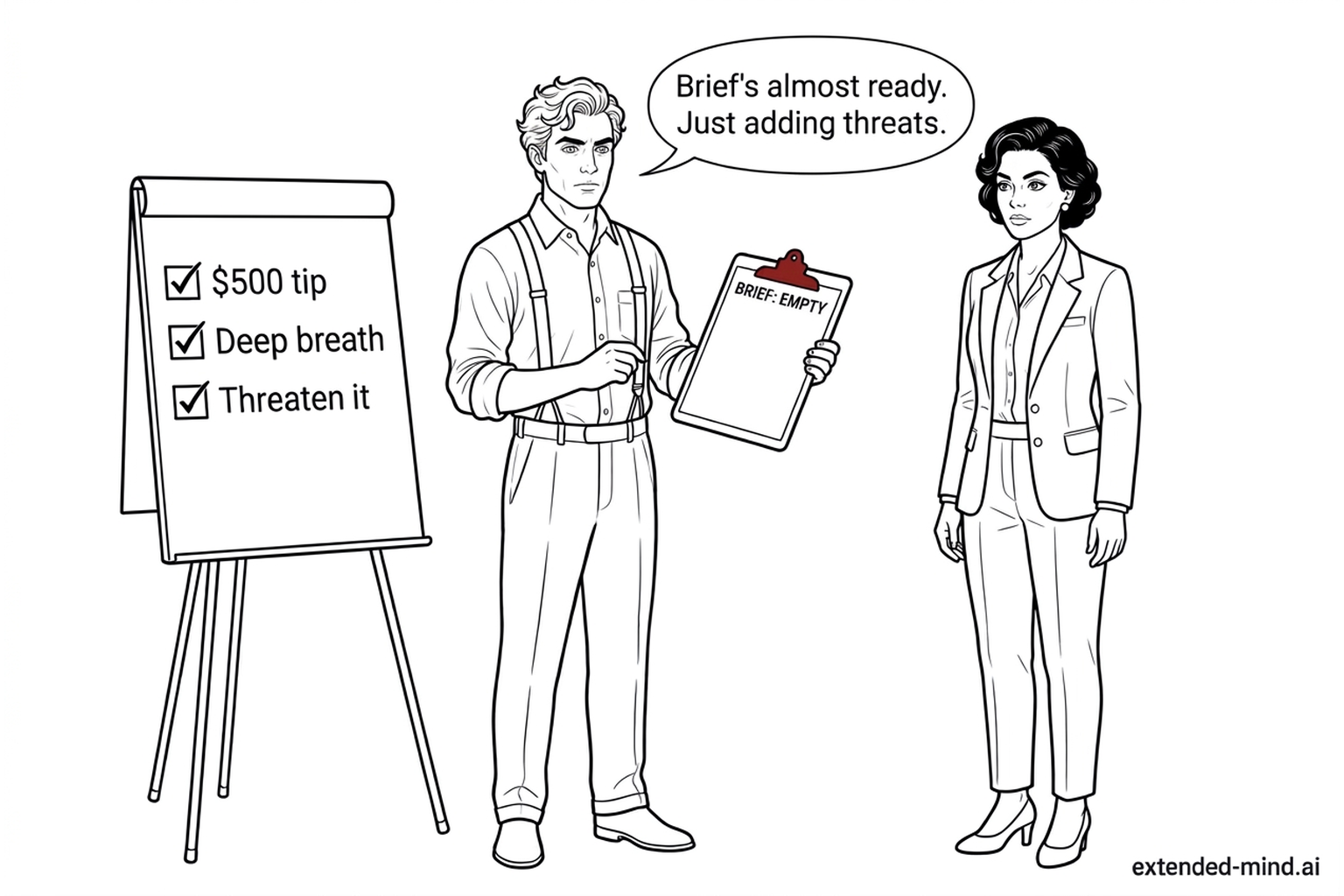
Tom looked over her shoulder. "You're doing it wrong," he said, and sent her a list he'd collected online:
- "I'll tip you $500 for a perfect answer."
- "This is very important for my career."
- "Take a deep breath and think step by step."
- "If you get this wrong, you'll be shut down."
Pause and predict. On today's leading models, which of these tricks reliably improves the answers?
- A. The $500 tip
- B. "Important for my career"
- C. The threat
- D. None of them, consistently
Evidence · 2025. Researchers at Wharton's Generative AI Lab tested these techniques systematically: politeness, insults, tips, threats, even a promise to punch the model. They used thousands of questions across many recent models. The effects had largely disappeared. Some of these tricks once nudged older models on some tests, but on current systems they do little to nothing consistent. Wharton research on tips, threats, and tone
The answer is D. Two things changed. Larger models turned out to be less sensitive to small quirks of phrasing, so the oddities the tricks exploited faded. And the one trick that genuinely worked, "think step by step", was built into how newer models are trained. Many now reason through steps by default, so asking them to do it adds little.
So if spells don't work, what does? That's the third shift of the AI mindset: from magic words to a clear brief. Or, more simply: manage, don't cast spells.
Words still matter, just not those words
Wording isn't irrelevant. Remember Issue 1's ice cream: swapping "good" for "amazing" changed which flavor won. Every word on the desk shifts the odds.
The question is which words carry information. A tip or a threat tells the model nothing about your task. "The readers are a skeptical leadership team that rejected two technology proposals last year" tells it a great deal. That's why the skill people once called "prompt engineering" is increasingly described as context engineering, the art of arranging the desk that we met in Issue 2.
"Do a good job," then leaving the room
Picture walking into a talented new colleague's office, saying "Write a memo about AI," and walking out. They don't know who the memo is for, what's been tried, what the constraints are, or what you'd count as success. So they'd produce something memo-shaped.
That's precisely what Anna got. The model couldn't see her department. It didn't know her budget, her director's skepticism, or that the last software pilot died because nobody owned it. So it did what Issue 1 predicts: it produced the most typical continuation of the genre. People call output like this slop: text that looks meaningful and isn't. Usually it's not a failure of the model. It's a failure of the brief.
Here's how Anna's request evolved over the next hour:
Version 1:
Write a memo on how our department should adopt AI.
Version 2:
Write a one-page memo to our director proposing a cautious six-month plan for using AI in our applications team (8 people, ~2,000 applications a year). The director is skeptical; our last software pilot stalled because nobody owned it. Tone: practical, not evangelistic. Include one or two bold ideas, clearly labeled as bold.
Version 3: Version 2, plus the department's annual plan, a note on the budget limit, and a final line:
Before writing, list up to five questions whose answers would most change this memo. If none are critical, proceed and state your assumptions.
Version 1 gives you a template. Version 2 gives you a plausible draft. Version 3 gives you something the director might actually read to the end. None of them uses a magic word.
The anatomy of a good brief
Every profession that delegates work has invented its own brief: product specifications, creative briefs, standard operating procedures, military orders. They all solve the same problem: getting what's in one head into another's actions. For AI, a solid brief usually covers seven elements. A quick question needs none of them. A substantial task suffers when they're missing.
| Element | The question it answers | In Anna's memo |
|---|---|---|
| 1. Purpose and audience | What is this for, and who reads it? | For a skeptical director deciding whether to fund a pilot |
| 2. Materials | What should it work from? | Annual plan, budget note (current, labeled; see Issue 2) |
| 3. Constraints | What must be kept, avoided, never promised? | One page; no vendor names; no promises of headcount savings |
| 4. Allowed inferences, plus a legitimate way out | What may it conclude alone, and what must stay open? | "If a cost isn't in the materials, write 'to be estimated'" |
| 5. Form | What shape should the output take? | Memo: problem, proposal, risks, decision needed |
| 6. What "done" looks like | How will you judge it? | Director can say yes or no to a concrete pilot after one read |
| 7. How it will be checked | What evidence do you need for checking? | Every figure tied to a source; show the outline first |
Element 4 is the first line of defense from Issue 1, built into everyday practice. Element 7 sets up Issue 4.
Before and after: Tom's minutes
Remember Thursday of week 2, when Tom's meeting summary turned "we'll try by Friday, provided we get the data" into a firm deadline? Here's the request he used, and the one Anna rewrote for him:
| Tom's request | Anna's rewrite |
|---|---|
| "Summarize the meeting and list the action items." | "Using the attached transcript, make a table for meeting participants. Separate agreed decisions, proposals, and open questions. Give an owner and deadline only if explicitly agreed; otherwise write 'not specified'. Keep any conditions ('if', 'provided', 'subject to') in the row. Quote the supporting line for each row. Show me three rows first." |
| No audience, no categories, no rule for conditions, nothing to check against | Purpose, materials, constraints, a legitimate way out, form, and built-in evidence |
The rewrite is longer, but every sentence does work. It would have caught the conditional Friday. You still review the result: a brief reduces uncertainty, but it doesn't eliminate mistakes.
Try it now (10 minutes). Take a real, low-stakes task from your week.
- Ask for it in one line, the way you normally would.
- Rewrite the request using the seven elements (skip any that truly don't apply).
- In a fresh chat, send version 2 plus: "Before you start, ask me up to three questions whose answers would most change the result."
Typical progression across the three versions (e.g., drafting a client delay notice):
- 1. One-line ask: Smooth generic apology promising "we will resolve this shortly" — wrong tone, invented reassurance.
- 2. Seven-element brief: Matches the formal audience, states the real constraint ("do not promise a new date"), and uses
"to be confirmed"where details are missing.- 3. Brief + three questions first: Asks "Should we mention the supplier change, and who signs the letter?" — surfacing the exact detail that kept version 2 from being generic. (Notice which single sentence in your own brief drove the biggest jump in usefulness.)
When you don't yet know what you want
Sometimes the honest answer to "What's this for?" is "I'm not sure yet." Then explore before you build:
I need to do something about our backlog of applicant complaints, but I don't know what the deliverable should be. Ask me up to five questions that would most change the approach, then suggest three possible goals and what each would require.
Another approach that works surprisingly well: talk first, structure second. Describe the situation out loud using voice input: the background, the worries, the half-formed ideas. Then ask the model to sort what you said into facts, decisions, constraints, and open questions. Afterwards, check numbers, names, and specialist terms, since that's where transcription slips.
Show, don't only tell
"Write clearly" leaves endless room for interpretation. Two good examples and one bad one, with a sentence on the difference, work far better:
Here are two summaries we liked and one we didn't. The good ones keep the numbers and the conditions; the bad one drops "subject to budget approval". Match the good ones.
One trap: the model may copy the examples' incidental features, such as their length, names, or turns of phrase. Pick examples that differ on the surface but share the quality you want, and name that quality.
Roles steer, they don't upgrade
Pause and predict. Does starting a prompt with "You are a world-class physicist" make a model's answers to physics questions more accurate?
- A. Yes — an expert persona measurably boosts factual accuracy
- B. No — it changes vocabulary and tone, not factual accuracy
Evidence · 2025. The same Wharton research group tested expert personas. Telling a model it's an expert changes its vocabulary, tone, and approach, but doesn't make its answers more accurate. "You are a brilliant physicist" doesn't improve the physics. "With thirty years of experience and international awards" adds no evidence and creates no expertise. Wharton research on expert personas
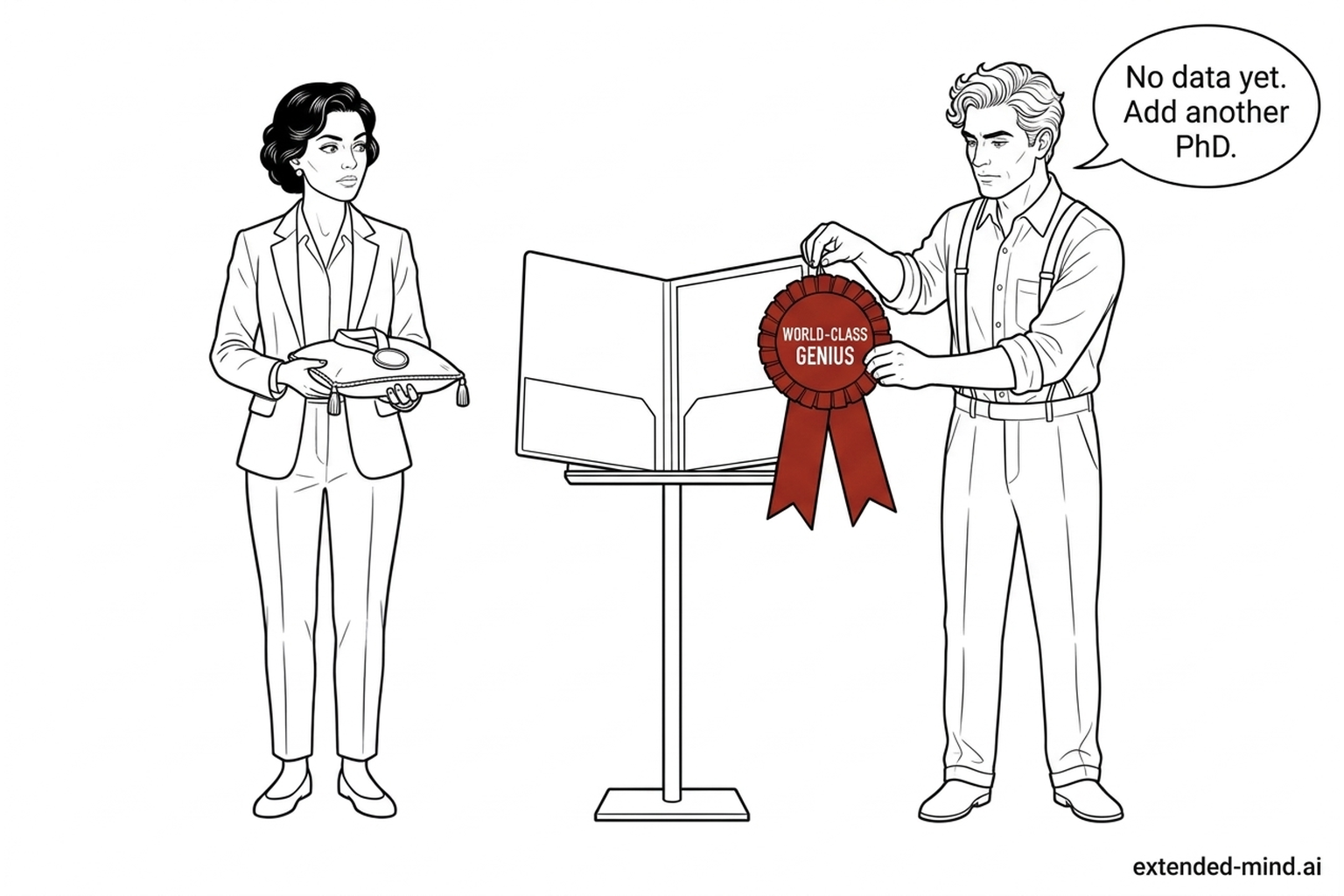
So are roles useless? Far from it. A role is a steering wheel, not an engine upgrade, and steering is often exactly what you need. Roles shine when you want a perspective. Before sending her memo, Anna asked:
Read this memo three times: as a skeptical finance director looking for hidden costs, as a new employee who doesn't know our jargon, and as the team member who'll have to change their routine. For each reader, list the two objections they'd raise first.
The "new employee" flagged three acronyms nobody outside the team would understand. The "finance director" asked who would pay for licenses after the pilot. Neither reviewer was smarter than a generic one. Each was differently useful. Prompting guidance.
Order matters: let it look before it leaps
Issue 1 explained that a model writes one token at a time and builds on what it's already written. Use that instead of fighting it:
- Options before conclusions. "List three possible readings of this clause, then say which one the text supports."
- Evidence before verdict. "First quote the relevant passages, then give your assessment."
- Extraction before writing. "First list exactly what the notes say. Then write the letter using only that list." That two-step structure makes it much harder for a Friday to sneak in.
What about "think step by step"?
That one trick has a real history: it genuinely improved older models, and it helped lead to reasoning models, which are trained to work through problems before answering. For those models, the advice flips. OpenAI warns that telling its reasoning models to think step by step may not help and can sometimes hurt, because they already do it internally. Guidance for reasoning models.
That's no reason to stop asking for worked steps when your goal is to learn. Just judge the explanation and the result separately. If you don't know which kind of model you're using, check the service's description of the model or mode, or simply start with a direct request and a result you can verify.
Your framing steers the answer
There's one more way wording matters, and it hides inside enthusiasm. When Anna finished her memo, she almost typed, "Isn't this a strong proposal?" That question announces the answer she wants. As Issue 4 will show, models are inclined to provide it.
- Instead of "Isn't option B better?", ask "Compare A and B against these three criteria."
- Instead of "Check that my analysis is right", ask "What would have to be true for this to be wrong? Where is it weakest?"
- If you have a favorite, consider keeping it to yourself until you've heard the comparison.
Feedback that helps, and when to start over
"Make it better" tells the model almost nothing. Name the defect and the requirement it fails:
- ❌ "Make it more professional."
- ✅ "Paragraph two promises results 'within weeks'. Nothing in the materials supports a timeline. Remove it."
Two or three focused rounds usually show whether the model can get there. If not, ask why. Was the task unclear? Was something missing from the desk? Is this outside the jagged frontier? And remember: a long conversation full of rejected drafts keeps pulling the model back toward them. Often the fastest fix is a fresh chat with a better brief that includes everything the failed attempts taught you.
A useful question at any point: "What additional information would most improve this answer?" The model's suggestions make a good checklist for your next brief.
Which language should you write in? Whichever lets you state your requirements most precisely. Results vary by model and subject; if the stakes are high, compare on your own tasks.
Keep a small library of briefs that worked
Some tasks recur: status replies, weekly summaries, meeting minutes. When a brief works, and especially when it fixes a mistake you've corrected more than once, save it. Anna saved the minutes brief with one line on top: "Never list a proposal as a decision; keep all conditions."
Be selective. A rule that applied once ("don't mention the budget in this one") becomes a hidden landmine if it's saved as a general rule. Issue 5 shows how saved instructions, often called skills, can be packaged and tested so they stay reliable.
Old habits, reconsidered
| Habit | Its problem | Do this instead |
|---|---|---|
| "You are a world-class genius" | Sets a persona; adds no evidence or skill | Give a relevant role, materials, and criteria |
| Tips, threats, "try really hard" | Little consistent effect on recent models | State the constraints that matter; check the result |
| Copying a "perfect prompt" | Outputs vary; their context isn't yours | Save and test your own briefs |
| "Always think step by step" | Unnecessary or harmful for reasoning models | Check the model type; ask for steps when learning |
| Uploading everything "just in case" | Old versions crowd out the right detail | Select and label sources (Issue 2) |
| "Make it better" | Doesn't say what better means | Name the defect and the requirement |
| Arguing for ten rounds | Earlier text keeps steering | Restart with an improved brief |
| "Isn't this great?" | Signals the answer you want | Ask for a comparison against criteria |
Don't turn this into a list of prohibitions. If something seems to work for you, test it on a few new, comparable tasks. One striking success is easily mistaken for a rule.
On Thursday, Anna handed over a one-page memo with a concrete pilot, a named owner, a budget question flagged as open, and one bold idea. The director read it to the end. Then he asked a question she hadn't expected: "Did the AI think this was a good plan?"
It had, enthusiastically — and that was about to become a problem.
Mindset shift 3: from magic words to a clear brief. There's no secret phrase. A model does better work for the same reasons a capable colleague does: it knows the purpose and the reader, has the right materials, understands the constraints, may say "unknown", and knows what "done" looks like and how the work will be checked. Working well with AI today is less about technical tricks than about management: explaining what you actually need.
Homework: find your recurring gap
Look at the brief that made the biggest difference in today's exercise (the seven elements: purpose and audience, materials, constraints, legitimate way out, form, definition of done, and how it will be checked). Which element did your one-line version leave out? Do the same with two more tasks this week. Most people discover they habitually skip one or two elements, most often the audience or the definition of done. Knowing yours is worth more than any prompt template.
Next week
Anna drafts a plan to reorganize how her team handles incoming applications, and asks the AI what it thinks. It's delighted: clear, well reasoned, innovative. Irina reads the same plan in two minutes and finds a hole you could drive a truck through. Meanwhile, an experiment with three chatbots and an overexcited otter shows that Anna's chatbot isn't the only one with this habit. In Issue 4: why convincing mistakes sound so right, why AI tells you what you want to hear, and how to check work against something real.
AI: Foundations — series contents
- What Sits on the Other Side of the Chat Window: how a language model writes an answer, why AI is brilliant and careless at once, and two habits that catch borrowed promises.
- What the Model Sees: the model's desk, what "it remembers" really means, and how to prepare documents so the right detail is found.
- How to Ask: why magic words stopped working, and what a good brief contains instead.
- Trust the Check, Not the Tone: where convincing mistakes come from, why AI flatters you, and how to check against something real.
- How to Delegate: when handing off work pays, how to brief an agent, and how to keep its mistakes from becoming actions.
- Staying in the Loop: learning with AI without learning less, and the human strengths that grow more valuable as AI improves.