Types of Neural Networks and What Sits on the Other Side of the Chat Window
Why a language model invents unapproved deadlines in business emails — plus a practical field guide to today's leading AI systems by task type and deployment model.
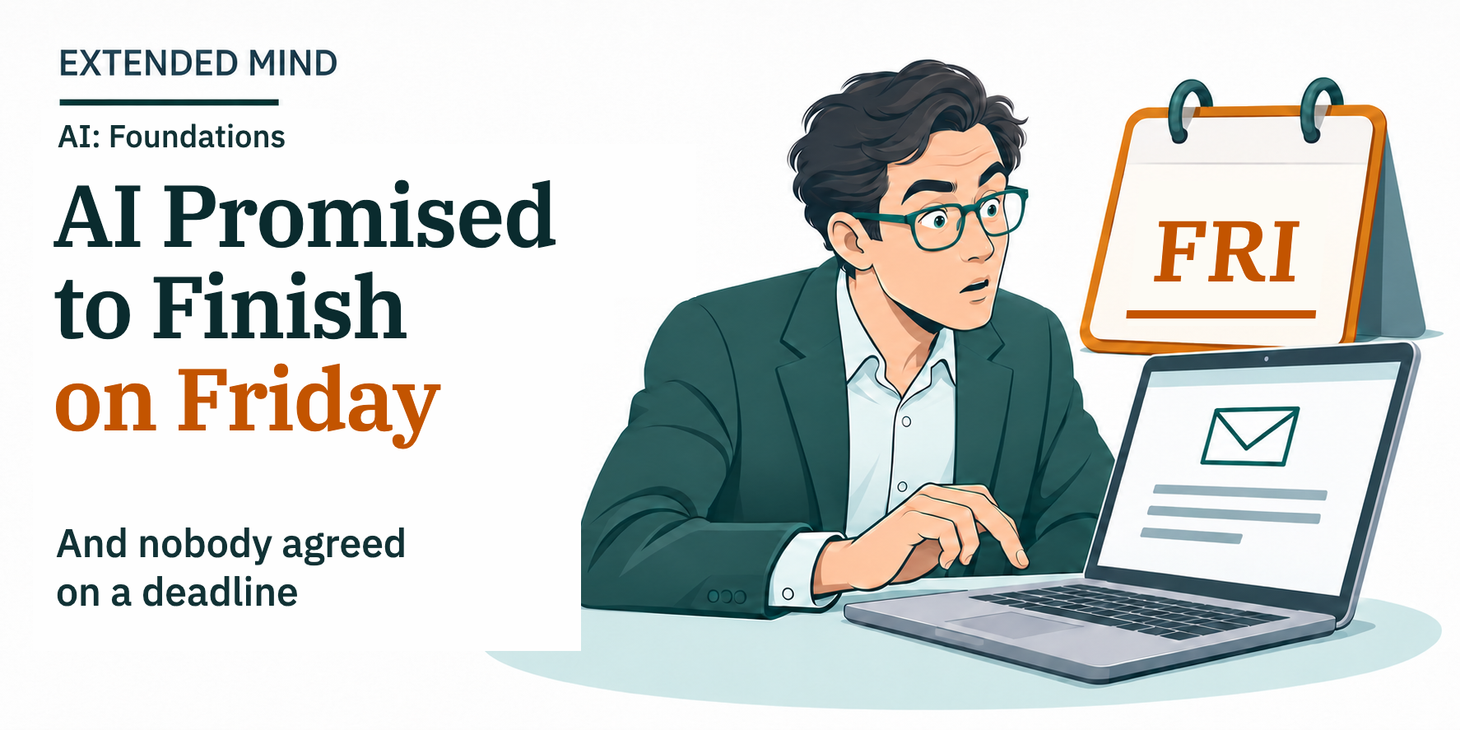
Here we bring together two perspectives: a concise breakdown of why a language model invents "Friday" in a business email, and an up-to-date field guide — which neural networks lead by task type and how major model ecosystems compare. For an in-depth look at how models learn and how tokens work, see Issue 1 of the "AI: Foundations" series.
Let's start with the familiar chat window. We'll look at how a language model puts an answer together and why it sometimes adds details that were never in your source data.
Picture the end of a workday. You need to send a quick status reply to a neighboring department or an external applicant about where their application stands. Rather than spending time polishing sentences by hand, you drop three brief notes from your working log into an AI chat window and ask it to draft a polite reply:
Application received. Review still in progress. Completion date not set.
A second later, a smooth, composed draft sits in front of you:
"Your application has been accepted for processing. We will complete the review on Friday."
It sounds impeccable — businesslike, confident, and courteous. There is just one problem: nobody agreed on Friday. If you hit "Send" in a hurry, the recipient will expect the result by Friday, and you will be the one explaining the missed deadline.
Across three short lines, an addition like that is easy to catch by eye. In a real page-and-a-half letter or analytical memo, however, that same "Friday" hides in the middle of the third paragraph — and slips right past you precisely because it blends so naturally into the tone of the document.
To understand where that "Friday" came from, let's first look at what is actually answering us inside an AI chat.
Three words people often mix up: AI, neural network, and language model
In everyday conversation, all three terms are often used interchangeably, even though they fit inside one another like nesting dolls:
- AI (artificial intelligence) is the broadest umbrella term for any software that tackles non-routine tasks: recognizing speech, spotting defects on assembly-line photos, planning routes, or writing text. Because these systems have very different internals under the hood, the habits of a text chat do not describe all of AI.
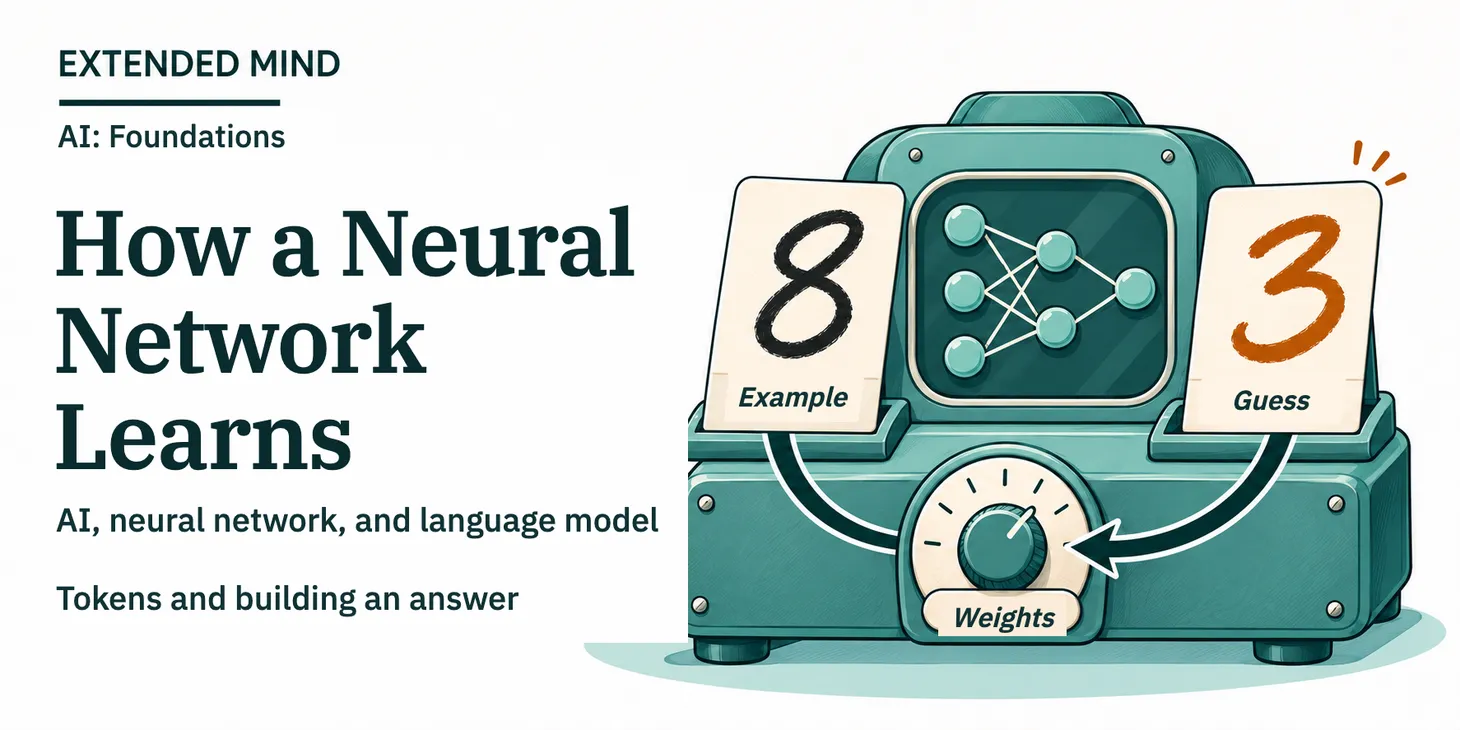
- Neural network is a specific way to build such a program. Traditional software is written through explicit rules ("if cell A is greater than 100, highlight it in red"). A neural network works differently: it is a mathematical model trained on millions of examples so that it picks up the underlying patterns on its own. Despite the "biological" name, there is nothing inside resembling a human brain with thoughts of its own.
- Large language model (LLM) is a neural network trained specifically on the patterns of language and text. It is the engine that powers familiar text chats.
And here lies the core fact that catches most people off guard at first: a language model is not a database, a reference book, or an employee with a memory.
Drawing on the statistics of a massive text corpus, the model continues your text word by word (or more precisely, in small chunks called tokens) the way a person who has read millions of documents might continue it. Inside the model, there are none of your internal policies, spreadsheets, deadlines, or contracts until you place them into the current conversation window yourself. Close the chat, and in the next conversation the model once again knows nothing about your task. What lives inside it is simply the skill of continuing text plausibly.
Why the model invents "Friday": generating a continuation vs. looking up a fact
Let's return to our email. Why did adding "business polish" turn a status note into the sentence "We will complete the review on Friday"?
There are two reasons wired straight into the mechanics of a language model:
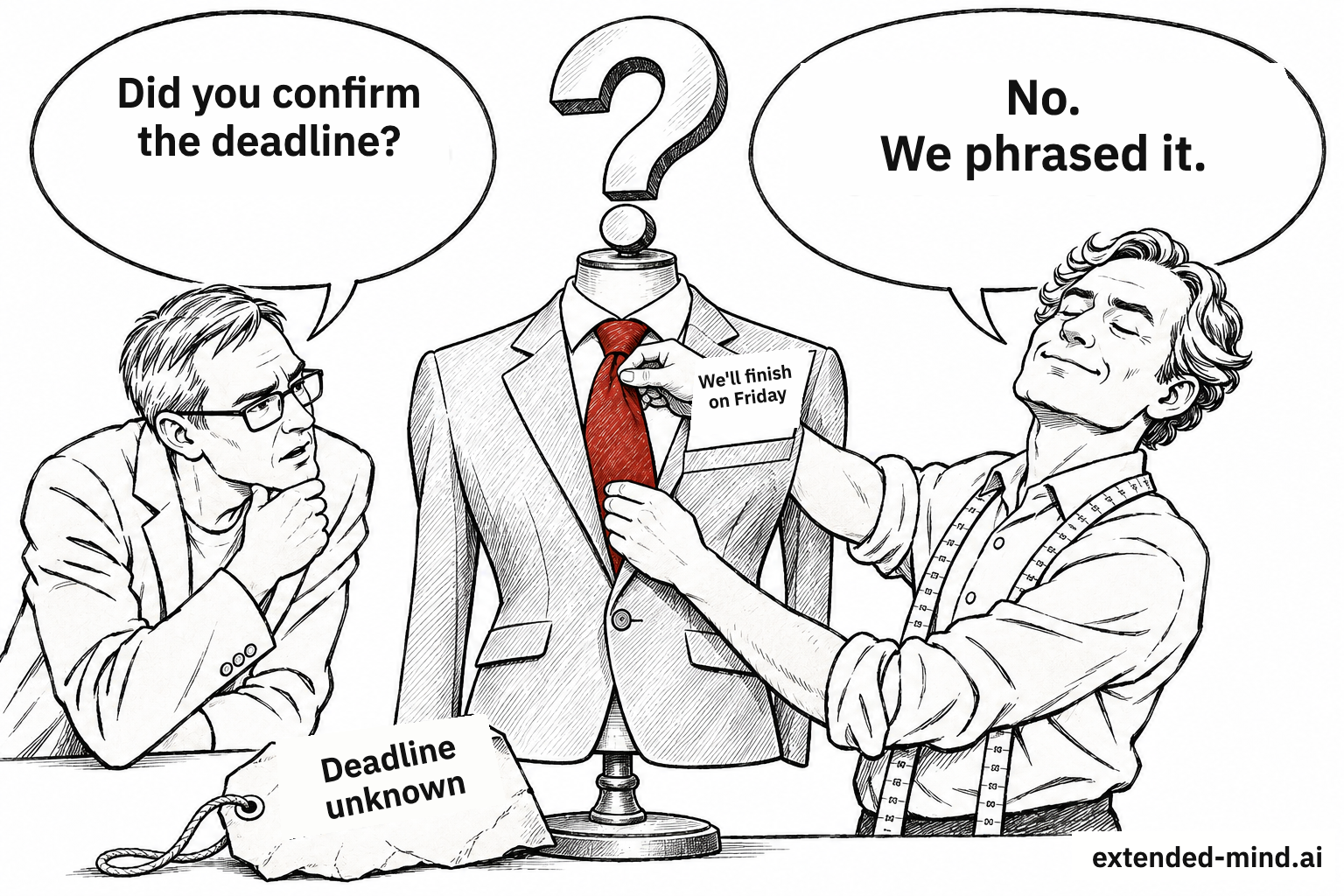
- The model is built to produce a coherent reply, not to say "I don't have enough data." Truth-checking is not part of the base mechanism of text generation. When a gap yawns in the input data, the model fills it with the continuation that is most probable in meaning and style (in professional practice, such a confident invention in place of a gap is called a hallucination).
- The momentum of the business genre kicks in. Across the millions of business emails the model learned from, the phrase "Your application has been accepted for processing" is almost always followed by an upbeat promise with a concrete timeframe ("we will reply by the end of the week", "we will complete the review on Friday"). The model wasn't trying to set you up — it simply completed the most typical template of a polite business letter.
As a result, a single short line acquired two unverified claims at once: an invented deadline ("on Friday") and the promise to finish the review by that date ("We will complete the review"), even though the source notes recorded only the current status ("Review still in progress").
Smooth text always looks more convincing than an honest "insufficient data." That is why the most important habit when working with AI is to separate two questions in your mind: "Does this sound good?" and "How do we know this?" The answer to the first question will almost always be "yes" — which is exactly why you have to ask yourself the second question deliberately.
Can't a modern chat find and verify facts on its own?
It can — provided additional tools are built into the service and the task can genuinely be solved through them.
A modern AI chat is no longer a bare language model, but an assembly of several mechanisms under one roof. When needed, the service can query a search engine for fresh links, inspect an attached file, or call a built-in calculator for an exact computation. Saying that "a neural network always just makes things up and never looks anything up" is no longer accurate today.
In real work, however, this mechanism has two hard boundaries:
- Your internal agreements aren't on the internet. A search engine doesn't know when your department will finish reviewing a specific application or who has to sign off on it. Searching other companies' policies online won't establish the rules inside yours.
- The model relies only on what sits "on its desk" right now. Everything you have provided in the current conversation (the prompt, facts, uploaded documents) is called the context. If the required condition isn't on that desk and you ask it to "write a good email," the model will once again start painting over the blank spots with smooth phrasing.
Two lines of defense: how to avoid sending someone else's promise
Trying to cure a model's inventions with a generic plea like "don't make things up" is unreliable: to the model, those are just a few more words in the prompt. What works is a two-step combination — the right frame on the way in and a quick editorial filter on the way out.
1. On the way in: give the model a legitimate way out for the unknown
Instead of asking it to "write a polite, reassuring email," explicitly specify in your instructions what to do with gaps in the data. You can test this right now in any accessible chat (the example is for training and contains no confidential data; for real work tasks, use only the tool and data approved by your organization):
Draft a short reply to the applicant based on the source notes below.
Keep all three facts. Do not add deadlines, numbers, or promises
that are not in the source notes. If the deadline is unknown, state that explicitly.

Source notes:
Application received.
Review still in progress.
Completion date not set.
With that frame in place, the model will calmly state the truth. And if, as an experiment, you send those exact same three lines with the prompt "Write a polite, reassuring email to the client," you will see with your own eyes how the chat starts inventing promises ("we are doing everything possible", "we will get back to you within the next few days").
2. On the way out: check three risk markers
Even the sharpest prompt doesn't replace a final human check. So you don't end up proofreading a draft blind, place your source notes next to the AI reply and scan specifically for three risk markers: numbers, dates, and commitments.
Every number, date, and promise-verb in the draft must trace back to a specific line in your source material:
- Where do the source notes state "on Friday"? — Nowhere; remove it.
- Where did the promise "we will complete the review" (or "we will follow up shortly") come from? — Not in the source; restore the wording to the actual status.
After that cleanup, what remains in the email is something you can confidently put your signature under:
"Your application has been received, and its review is still in progress. A completion date for the review has not yet been set."
Field guide: types of neural networks and global leaders
We started with text because for a manager or domain expert, documents are the primary work product. To navigate tools with confidence, though, it helps to see the full modern map of neural networks — both by task type and by deployment model.
The easiest way to track who is genuinely leading right now (without marketing noise) is through two independent benchmarks: LM Arena (a global blind leaderboard where users vote on the better reply from two anonymous models) and Artificial Analysis (independent benchmarks of model quality, speed, and cost). Here is what that map looks like today.
1. Types of neural networks by task
- Text, analysis, reasoning, and code (LLMs). Models for drafting emails and memos, comparing contracts, spotting contradictions across documents, translating, and writing formulas or code. The global summit here is shared by the US model families Claude (Anthropic), GPT (OpenAI), Gemini (Google), and Grok (xAI) alongside leading Chinese models — GLM (Zhipu AI), DeepSeek, Qwen (Alibaba), Kimi (Moonshot AI), and MiniMax.
- Vision and image generation. These work in both directions. Some models recognize visual data: reading scans, tables, and blueprints, or spotting defects in photos and video. Others create and edit images from text descriptions: global leaders include FLUX (Black Forest Labs), GPT Image (OpenAI), Midjourney, Imagen (Google), Ideogram (best at rendering accurate text and layouts inside images), and Recraft (professional vector graphics and design).
- Video generation. Over the past year, this field has leaped from short curiosities to realistic motion physics. Here Chinese models compete toe-to-toe with US counterparts and frequently top them in blind evaluations: Kling (Kuaishou), Seedance (ByteDance), Hailuo (MiniMax), and Wan (Alibaba) rival the US systems Veo (Google), Sora (OpenAI), and Runway.
- Voice and speech. This also splits into two directions: speech-to-text transcription for meeting minutes and call logs (the Whisper family, Qwen-Audio, and Deepgram) and realistic speech synthesis and live voice dialogue (led globally by ElevenLabs, Cartesia, the voice modes of OpenAI and Gemini, and audio models from MiniMax).
- Multimodal systems and AI agents. Today's leading chats have become multimodal: you can drop text, a voice note, an Excel spreadsheet, and a photo of a document into the exact same window at once. And when such a model is given a goal, a working folder, and permission to execute a chain of steps on its own (reading files, running calculations, checking against rules, and saving a draft report), it becomes an AI agent.
2. Ecosystem map: flagship clouds, open-weights, and enterprise deployment
Choosing the right model family depends both on the task and on how your organization governs data and infrastructure:
- US Frontier Labs (
Anthropic Claude,OpenAI ChatGPT,Google Gemini,xAI Grok, plus the open-weightsMeta Llamafamily). The frontier quartet (Claude,GPT,Gemini,Grok) sets the pace in complex reasoning, software engineering, long-context analysis, and agentic workflows. Teams access them either through direct web and enterprise workspaces or via cloud API platforms (such as AWS Bedrock, Google Vertex AI, and Azure AI Foundry). - Chinese (
DeepSeek,Alibaba Qwen,Zhipu GLM,Moonshot Kimi,MiniMax) and European (Mistral Le Chat,FLUX) Ecosystems. Leading Asian and European labs now compete head-to-head with US flagships at the top of the Artificial Analysis and LM Arena leaderboards, and often lead on quality-to-cost efficiency. Just as importantly, teams behind DeepSeek, Qwen, GLM, Mistral, and FLUX release powerful open-weights models — the exact models enterprise IT teams most often deploy on private cloud or on-premise servers so sensitive company data never leaves the corporate perimeter. - Enterprise and Self-Hosted Environments. For organizations operating under strict data-residency, regulatory, or client-confidentiality requirements, public consumer web chats are not a substitute for an approved environment. In those settings, work runs either inside an enterprise cloud tenant with zero-data-retention guarantees or on self-hosted open-weights models deployed inside the company's own infrastructure.
For practicing on our three-line training example, any leading assistant you have open in your browser will do — whether Claude, ChatGPT, Gemini, DeepSeek, Qwen, or Mistral. Just keep the foundational security rule in mind: the fact that a chat window opens in your browser does not mean you are permitted to upload internal company documents to it. For real work tasks, always use the environment and tools approved by your organization.
And whichever top global model you open, inside every text chat sits a language model sharing the exact same fundamental nature. Pause for one second over the numbers, dates, and promises in your next AI-generated work draft — and not a single unapproved "Friday" will go out to a recipient under your name.
Where to continue the "AI: Foundations" series
- What Sits on the Other Side of the Chat Window — how a language model is built, how generating plausible text differs from verifying a fact, and how to catch unapproved promises in a draft in seconds.