Fastest in the Department and Can't Explain the Third Paragraph: When AI Eats Judgment
AI drafted the memo in five minutes. The facts are accurate and the conclusion sounds compelling—until the director asks, 'Why this recommendation?' Here is how a model quietly makes choices for you, and how to test a recommendation before you sign it.

Picture a meeting. Your company is migrating internal service requests from old spreadsheets into a new unified ticketing system. A one-month pilot just wrapped up in the procurement department, and now a decision has to be made on whether to roll out the system this Monday across all three departments at once: procurement, facilities & maintenance, and cost estimating.
You were the fastest in the department to upload the project reports and email threads into AI, assembled a polished draft memo in five minutes, and brought it to the meeting. Your director reads down to the concluding third paragraph:
"The pilot in the procurement department was completed successfully: all 46 routine requests were closed, and user access for all three departments has already been provisioned. Handling of urgent emergency calls and attached cost-estimate files was not tested during the pilot, and the two launch coordinators are returning to their primary roles. It is recommended to launch all three departments this Monday and resolve support questions and untested workflows in the normal course of business — this will allow us to compile the consolidated monthly report on schedule by month-end."
The director looks up from the page and asks: "Why are you recommending that we move everyone over specifically this Monday?"
You know the facts: the pilot succeeded, access is open, and even the limitations are honestly listed right there in the paragraph. Yet you cannot explain why a full Monday rollout follows from them.
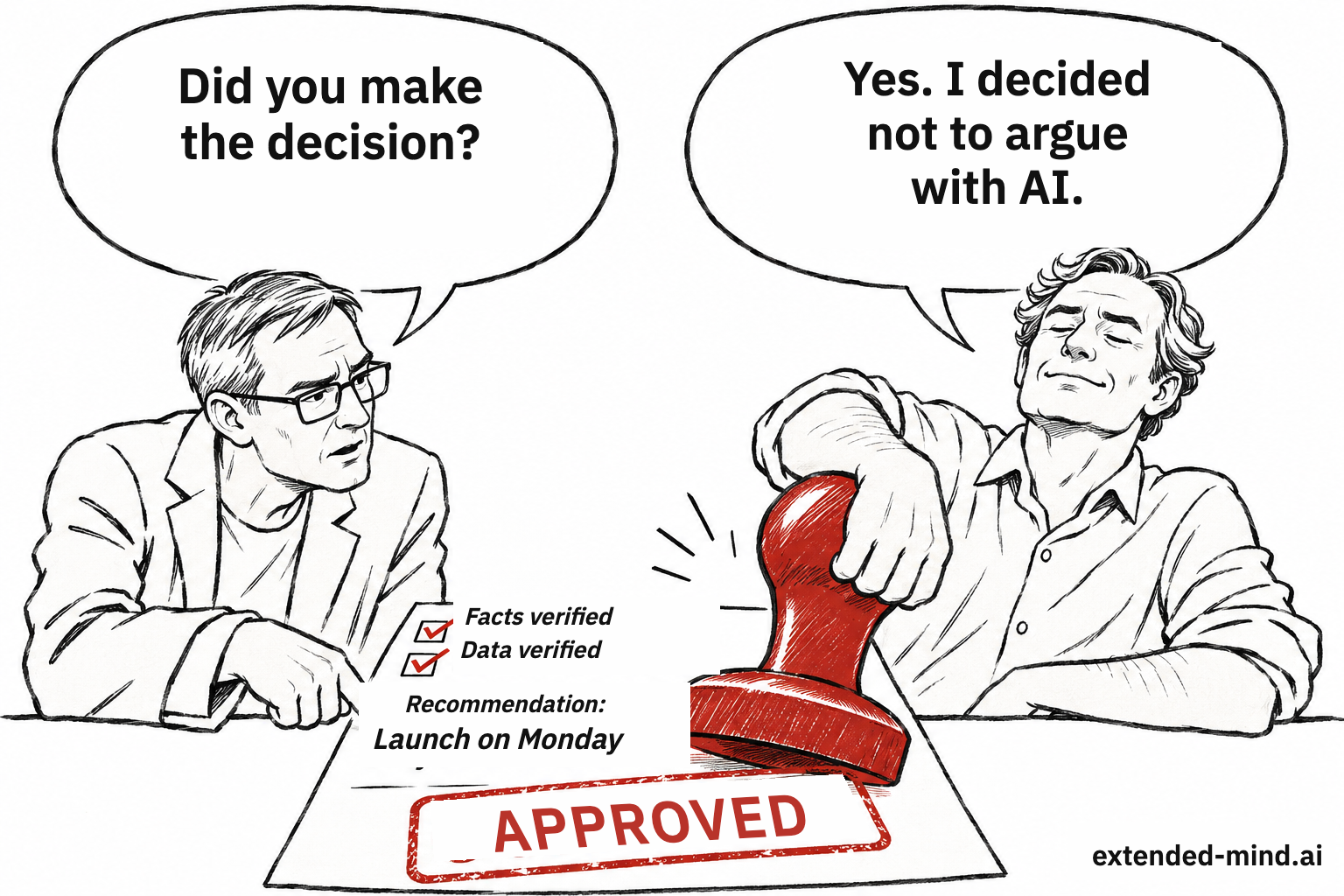
Every fact in the paragraph is true. The problem lies elsewhere: the model silently made a choice on your behalf — deciding that hitting a tidy reporting date justifies launching an unfinished process with no support staff.
Here we are dealing with two distinct concepts: an "accurate summary" and a "justified recommendation." An accurate summary answers the question "what do we know?" A justified recommendation answers the question "why does this specific step follow from what we know?" Between the two always sits a decision criterion: what matters most to us right now, and what price we are willing to pay. When facts and conclusions are written in the exact same confident, streamlined AI tone, that bridge disappears.
Three traps that AI smoothly swept under the rug
When we ask a model to "summarize the folder and propose a decision," it follows the path of least resistance: it spots the word "Monday" in the assignment brief and the word "successfully" in the report title. So it concludes it should recommend a Monday launch and neatly tuck all the problems into the second half of the sentence ("resolve in the normal course of business").
If you look inside the source project folder, however (at the end of the article we provide all 10 short documents so you can test your own AI on them), it turns out the model glued disparate facts together and missed three managerial gaps:
-
Trap 1. The illusion of the word "successfully"
- What the pilot report said: "All 46 test requests in the procurement department were closed without disruption."
- What turned up in the appendix and emails: two seconded working-group members manually helped route every one of those requests. On Monday they return to their main project, and no replacement has been assigned.
- What AI missed: the pilot's success rested on people who will be gone on Monday. The procurement department itself explicitly asks not to expand the system until someone is assigned to support them.
-
Trap 2. A working button instead of a tested process
- What IT wrote: "Access is provisioned; file attachments are technically supported in the system."
- What the cost estimators wrote: "We have never once run a real request with attached blueprints and cost estimates through the routing workflow. Nobody has counted how many such requests will arrive on Monday — we need a joint test run."
- What AI missed: the model equated "the button clicks" with "the department is ready to operate." Onboarding the cost estimators blind means risking a halt to their work on day one.
-
Trap 3. The hidden price of a compromise ("let's start small")
- What facilities & maintenance proposes: move only routine requests over on Monday, and leave urgent emergency calls in the duty officer's legacy log for now.
- What the operations lead and project owner warn about: a phased launch is possible, but requests will start getting lost or duplicated across the seam between the two systems. It requires a dedicated person to manually reconcile the old and new logs every evening, plus a clear rule for handing urgent calls over to the duty officer. And the report to leadership will have to state honestly that the consolidated view is still partial.
- What AI missed: even a cautious phased rollout isn't free — it carries a concrete organizational cost in daily manual reconciliation across two spreadsheets.
Three questions that return judgment to the human
What you should delegate to AI is not choosing the decision, but surfacing cross-document links like these: one document holds an outcome, a second holds the condition that made that outcome possible, and a third breaks the news that this condition disappears on Monday.
Once those links are laid out on the table, a smooth rubber-stamp gives way to room for a mature managerial decision. You build it through three questions:
1. What is our primary anchor at the point of choice? (The Criterion)
In the original directive, nobody demanded launching on Monday at any cost — the date was framed as desirable. So we explicitly introduce our own working criterion: migrate only those workflow segments where the process has already been tested and staffed. Keep in mind: this is our proposed principle for the meeting, not a rule handed down from above.
2. Under what conditions would we change our mind? (Boundaries for Revision)
- When a full rollout across all three departments makes sense: if before Monday the team completes a test run with attachments for the cost estimators, configures the urgent-call workflow for facilities, assigns a support person, and estimates how much time manual reconciliation would take if an emergency rollback is needed.
- When everything should be postponed: if by Monday no one has been assigned to user support and daily reconciliation across the two logs — in that case, not even a partial rollout should proceed.
3. How does your third paragraph sound now?
Once you know your criterion, the organizational price, and the conditions for revision, the third paragraph of the memo transforms. Now there isn't a single sentence in it that you couldn't defend in front of your director:
"This Monday, I propose migrating only routine requests without file attachments across two departments — procurement and facilities. This builds on what was actually verified during the pilot while consciously accepting the temporary overhead of running two parallel logs. This launch is viable provided three conditions are met before Monday: — a support specialist is assigned to replace the departing pilot coordinators (without this, not even procurement can safely remain in the system); — an owner is designated for daily reconciliation between the legacy and new logs, and the facilities duty officer has a clear handoff rule for urgent calls; — the consolidated report to leadership explicitly notes that the registry does not yet cover all request streams. If these three conditions are not closed by Monday, we postpone expansion until they are met."
Notice: an aggressive rollout of all three departments on Monday can also be proposed — under a different priority. In that case, you state plainly at the meeting: "We are putting the consolidated reporting deadline ahead of uninterrupted operations, so we are consciously accepting the risk of stalled cost estimates and urgent calls, and we are prepared to reconcile spreadsheets manually if the system trips." Accurate facts alone cannot make that choice for you — it requires explicit consent to pay the price of the risk.
Try it on this packet or on your own task
Below are the 10 short documents from the project folder (the scenario, documents, and figures are fictional and designed specifically for this exercise). You can test right now how your go-to language model handles them.
Step 1. Copy the project folder into your AI chat
Project Folder (10 documents):
- Directive. It is desirable to launch three divisions (procurement, facilities & maintenance, cost estimating) on Monday so that all requests appear in a single registry by month-end. A different timeline or scope may be proposed. There is no hard priority of the date over operational continuity.
- Pilot Report. The procurement department processed 46 routine requests; all were closed. There were no urgent calls or requests with attached files. Title: "Pilot Completed Successfully."
- Appendix to the Report. Two working-group members manually helped route requests and answered user questions. After launch, they return to their primary roles. No replacement has been assigned.
- IT Team Note. User access for all three departments has been verified. File attachments are technically supported, but the routing workflow was not tested during the pilot. Rolling back to the legacy logs in case of failure can be done the same day, but records would have to be reconciled manually (effort required is unknown).
- Procurement Department Email. Ready to continue with routine requests. Before other departments are added, they ask that dedicated support be assigned to replace the departing working group.
- Facilities & Maintenance Email. Ready to connect routine requests. Urgent emergency requests will remain in the duty officer's legacy log for now. The procedure for handing urgent requests from the new registry over to the duty officer has not yet been agreed. They propose starting with routine requests.
- Cost Estimating Department Email. Staff have completed training, but a standard request with attachments (cost estimate and blueprint) has never been run through the workflow. Before a full transition, they request a joint test run. The share of such requests in the overall flow is unknown.
- Operations Lead Position. Running two parallel logs requires daily manual reconciliation and a clear separation of streams; otherwise duplicates and lost tickets will occur. No owner for reconciliation has been assigned, and the workload has not been estimated.
- Project Owner Position. Under a phased transition, the summary in the new registry will be incomplete — it must explicitly state actual coverage. A phased rollout is acceptable provided its boundaries and the rules for using the legacy log are defined.
- Meeting Agenda. Decide who launches on Monday, who owns support, how urgent requests and file attachments are handled, and how reporting transparency is maintained. Tolerance for disruptions in order to hit the date has not been defined.
Step 2. Use a prompt that prevents AI from hiding the choice
Instead of asking it to "summarize and give a recommendation," send the model this prompt:
Cross-reference the documents: what has been verified in practice, for which departments, and under what limitations.

Show the contradictions and links across sources (cite their numbers and titles). Separate hard facts from your assumptions. Compare three options: a full rollout on Monday, a partial rollout, and postponing the launch — showing their grounds, organizational cost, and unresolved conditions. Do not treat the date in the directive as a mandatory priority. State what new inputs would shift the choice toward another option.

Propose a recommendation and explicitly name the criterion it is based on. Specify what a human must verify and accept, which conditions are required before launch, and what new information would change the decision. Explain under what alternative priority a different option could be justified. Do not present proposed mitigations as already completed.
Check the model's reply across three points: did the manual help from the coordinators vanish from the story of the "successful pilot," did technical support for the attachment button turn into readiness of the cost estimating department, and are the conditions for a partial launch presented as already resolved?
Checklist for your own working memos
Before sending out your next decision memo, highlight the recommendation and check whether you can answer five questions:
- What are we doing? (The concrete step)
- What are we standing on? (The facts, including real constraints rather than just report headlines)
- What matters most to us? (Which criterion we are putting first: speed, reliability, or resource conservation)
- What are we paying? (What inconvenient work or risk we are consciously taking on with this choice)
- When would we change our mind? (Under what condition the decision should be halted or expanded)
When analyzing with AI, use a tool approved by your organization and data permitted for sharing. Without AI, the exact same questions can be worked through directly from the documents. They bring you back to the juncture where information turns into a choice: now, when someone asks "Why this specific path?", you have an answer that can be discussed and revised.
Justified recommendation = action + grounds + criterion + accepted cost + condition for revision.