The “Ghost Action Items” Trap, or How AI Invents Tasks
The “ghost action items” trap: how to use AI to produce meeting minutes a manager can actually use to make a decision. Four steps, a ready-to-use prompt, and a checklist.
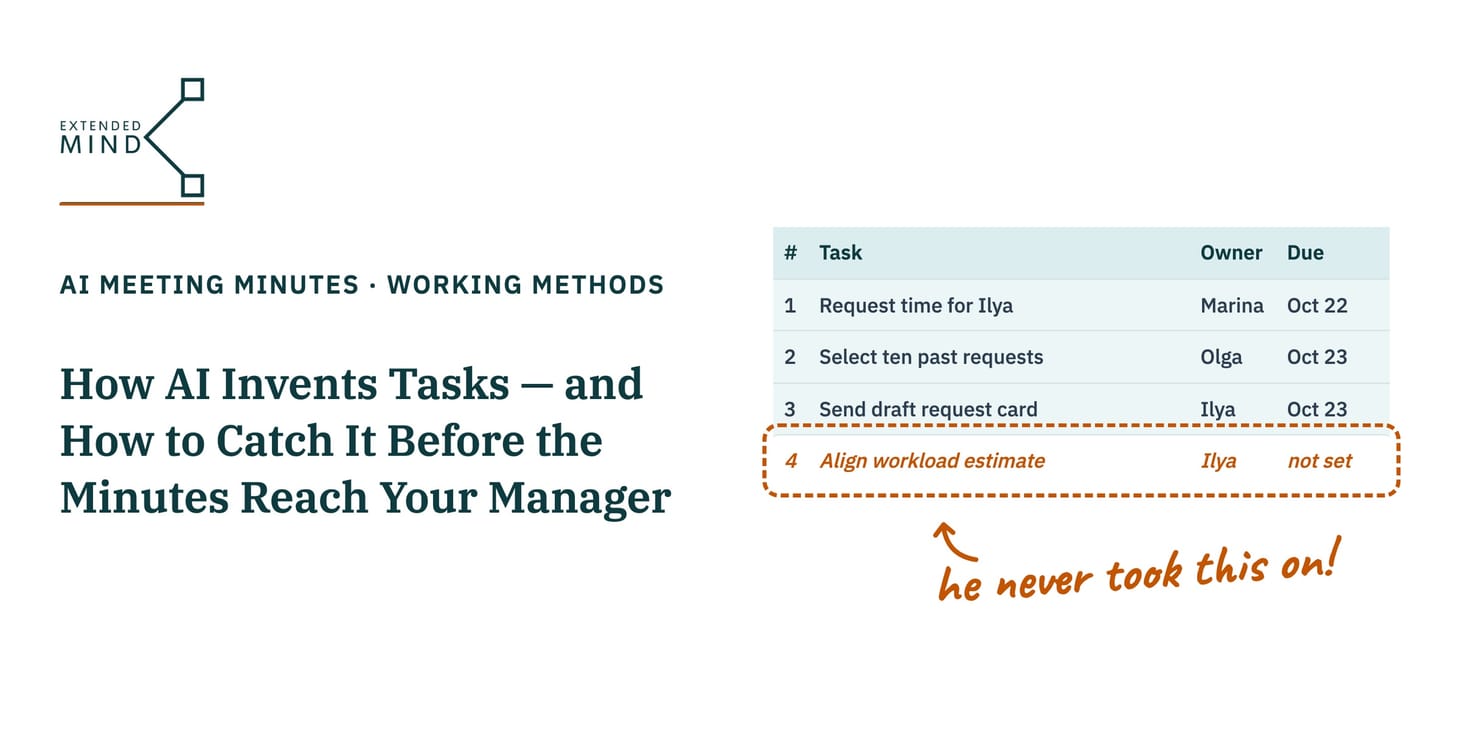
Let’s look at a familiar situation: a work meeting wraps up, you upload the transcript to an AI model, and you ask it to draft the meeting minutes — for yourself and for a manager who couldn’t attend. Within seconds, the model produces a neat document complete with tables and task lists. It feels like routine drudgery has finally been conquered.
Then, a few days later, problems surface when least expected:
- The illusion of agreement. The manager follows up with an employee on a task from the table, and the employee is genuinely baffled: during the meeting they merely remarked out loud that “someone should probably align on this,” without ever taking on the assignment.
- Distorted risks during compression. A colleague’s cautious doubt (“I wouldn’t promise that this will eliminate all delays”) gets compressed into a categorical verdict (“this will not eliminate delays”).
- Lost context by the next meeting. A week later the team reconvenes, but from the polished AI summary it is impossible to tell why that specific option was chosen, what constraints were considered, and what has changed since. Everyone has to dig back through emails, chats, and their own memory all over again.
The core takeaway of today’s issue: an AI model will produce a decent rough draft even from a one-line prompt, but YOU are the one who makes the minutes suitable for decision-making. For the document to actually work, you need to do two things: before generation — explain to the model what decision will be made from this text and by whom (and supply the hidden context that was never spoken out loud during the call), after generation — verify action items and conditions against the original recording using timecodes.
Need a ready-to-use template right now? Jump straight to the section “How to Apply the Method in a Single Prompt” — the final copy-paste prompt is waiting for you there.
A Real Experiment on a Training Case: A Decision Fork for Manager Alexey
To show concretely how AI helps and where it stumbles, let’s walk through a realistic workplace scenario (the company and characters are fictional, while the AI outputs are 100% real).
The company maintains e-commerce websites: clients submit tickets to fix bugs or modify checkout and payment pages. Taking part in a regular team meeting on October 22 are:
- Olga Sokolova (support specialist) — receives incoming client emails and clarifies details;
- Ilya Orlov (analyst) — translates client requests into clear technical specifications for developers;
- Marina Belova — leads the customer support team;
- Sergey Klimov — administers the internal ticketing system.
The core tension at the October 22 meeting: Ilya proposes a pilot (referred to in the transcript as a trial): for two weeks, he will personally review 20 checkout-form change requests per day and ask clients clarifying questions right away so developers receive a complete specification. That will take 2 hours every day. The catch is that Ilya already has two critical client specifications due on October 30 — a new checkout form for a furniture store and a payment page update for a sporting goods store.
Alexey Voronov, Head of Client Website Maintenance, who allocates resources between daily tickets and client commitments, missed this meeting. The minutes are meant specifically for him so he can make a concrete management decision: approve the pilot now (strictly without slipping the October 30 deadline on the two active specs) or postpone the experiment until those deliverables are handed over.
(The full transcript of this six-minute meeting is included at the end of the article.)
Step 1. A Simple One-Line Prompt: Quick Value and the “Ghost Action Items” Trap
Let’s test whether AI can handle the job without elaborate instructions if we simply ask it to write meeting minutes. We will evaluate the output through Alexey’s eyes: will he see his decision fork, the numbers, the launch conditions, and the team’s real commitments?
For the test, we passed the exact same plain-text transcript (without file attachments) to two tools running at high reasoning effort: Claude Code 2.1.309 (model claude-fable-5-1) and Codex CLI 0.163.0 (model gpt-6-astra)/GPT.
We started with the simplest possible prompt:
write meeting minutes from this transcript
Right on the first attempt, Codex / GPT produced a solid baseline, pulling out the key facts for Alexey:
| What the manager critically needs to see | How Codex formulated it on the first try |
|---|---|
| The core choice | “Two options are framed for Alexey’s decision: allocate time for Ilya to run a small trial without delaying two active projects due in 8 days, or return to the trial after they are delivered.” |
| Numbers and grounds | “Last week 46 requests came in. Clarifications were needed on 12 of them: for example, a link to the page or a description of how the order button is expected to behave.” |
| Launch conditions | “Work on the trial can begin no earlier than October 28, after confirming that the system is working and time has been allocated to Ilya. The launch date has not been approved.” |
Moreover, Codex accurately listed the tasks taken on by Marina, Olga, and Ilya, while leaving unassigned items (who will send the final summary email to Alexey and who will verify access to the new system fields) under “open questions.”
The report from the second model (Claude), however, is even more revealing — and had we sent it to Alexey as-is, it would have caused a management error. In the action items table generated by the model, a fourth row appeared:
# Task Owner Due 4 Align workload estimate with the head of analysts Ilya not specified
Now let’s open the original transcript and see what Ilya actually said:
[03:25] Ilya: By the end of October 23, I’ll send Olga a draft request card: link to the page, what happens now, and what the client wants to get. The estimate of my workload still needs to be aligned with the head of analysts.
What happened: Ilya only committed to sending the draft request card. He mentioned aligning his workload merely as a prerequisite condition — and 25 seconds later [03:50], Marina explicitly took on the task of asking the head of analysts for Ilya’s time. Claude turned Ilya’s remark into his personal action item (whereas Codex kept that point as an open question). Had Alexey read those minutes, he would have been waiting for Ilya to take steps Ilya had no idea he was responsible for.
- Why this matters: in this example, one model mistook the mention of a necessary step for a personal commitment, while the other did not. You never know in advance which output will contain an error like this.
- What you should do: even when a model’s first draft looks coherent and includes all the numbers, always verify the “Owner” column against what people actually said.
Step 2. Setting the Recipient’s Focus and Adding “Invisible” Context
Meeting participants live inside their shared workflow: on a call, nobody recites colleagues’ full job titles, recaps the history of prior meetings, or spells out background details on existing client orders. Without that background, however, the minutes remain “blind.” On top of that, a manager needs an executive summary, not a wall of text.
In Step 2, therefore, we expand our prompt with two blocks (keeping the original transcript unchanged).
1. Orienting the Document Toward the Decision-Maker
We add explicit instructions about the recipient and the decision they need to make:
Recipient — Alexey, Head of Client Website Maintenance. He missed the meeting and must decide whether to allocate analyst time for a trial of the new request intake process or postpone the trial. Start with his choice, the grounds, and the constraints.
Look at how the very first paragraph of Codex’s response changed immediately:
For Alexey’s decision: allocate time for Ilya to run a limited trial of the new request intake process without delaying two technical specifications due October 30, or postpone the trial until they are delivered. Approval for the trial has not yet been granted.
The facts are the same as in Step 1, but the architecture of the document has shifted: the moment the manager opens the message, the very first line tells him what is expected of him and within what boundaries.
2. Supplying Background Context (and Requiring It to Be Separated from the Meeting)
During the meeting, someone says, “you have two technical specifications due October 30.” What are those specifications? Are they already behind schedule? Did the participants have the authority to launch the pilot on their own? None of that is in the recording. Nor does the recording describe what the company or department actually does — background that often significantly changes how the final conclusions read. So we pass this knowledge to the model with a dedicated instruction:
Use the additional context below. Separate facts from the additional context from what was said at the meeting.
The context block itself does not need to be long:
The company maintains e-commerce websites. Alexey’s department handles tickets for bug fixes and feature changes on client sites. Support clarifies the client’s request; an analyst turns it into a technical specification that a developer uses to update the site.
Recipient: Alexey Voronov, Head of Client Website Maintenance. Allocates staff between incoming tickets and committed deliverables; decides whether to approve a trial with early analyst involvement. Missed the meeting.
Participants: Marina Belova — Customer Support Team Lead; Olga Sokolova — support specialist in that team, receives and clarifies client tickets; Ilya Orlov — analyst, writes technical specifications for developers; Sergey Klimov — administrator of the internal ticketing system.
Ilya’s two technical specifications are a new checkout form specification for a furniture store and a payment page modification for a sporting goods store. Both are promised to clients for October 30. Neither deadline is currently overdue. As of October 22, Ilya’s available time for the trial has not been confirmed.
The meeting outcome is needed by Alexey to choose between running the trial without delaying the promised client deliverables and postponing the trial. On October 19, it was agreed to first prepare options and assess workload, and then obtain Alexey’s decision. Until then, the meeting participants had no authority to launch the new process.
As a result, Codex wove these details in cleanly while flagging them with an essential label:
Additional context, not a meeting outcome: as of October 22, Ilya’s available time has not been confirmed. His two deliverables are a new checkout form for a furniture store and a payment page modification for a sporting goods store. Both are promised for October 30; there is no deadline slip.
- Why this matters: if you blend external background notes with participants’ spoken remarks, a week later nobody will remember whether the furniture store was discussed during the meeting itself or pulled from the issue tracker.
- What you should do: before generating, write 5–7 lines of context (people’s roles, which projects are referenced, deadline status, and where this information comes from) and explicitly instruct the model to separate this background note from the outcomes of the conversation. If there are inputs you don’t know yourself, ask the model to list them as clarifying questions.
Step 3. Requiring Timecodes and Protecting Meaning from Compression Drift
In live meetings, people debate, voice concerns, and in the final thirty seconds may reverse something they tentatively agreed on halfway through. To keep the model from confusing a personal opinion with an approved decision — and to make sure it respects late corrections — we give it strict source-handling rules:
Read the transcript in full. Distinguish decisions, confirmed action items, proposals, and opinions. Do not assign people or deadlines that are not in the source. Account for late corrections. Provide a timecode for decisions and action items; leave unknowns as questions. Preserve the rationale for the choice and rejected options.
What this achieved in Codex’s output:
-
Clear task status. The model added an explicit note: “Confirmed action items. The recording confirms acceptance of the commitments, not their completion,” and labeled Olga’s doubts as a “risk assessment.”
-
Late corrections tracked with timecodes. Mid-meeting [04:40], Marina suggested proposing October 26 as a possible start date. Then Sergey reminded everyone [05:05] that the ticketing system would be undergoing an update on the 26th, and Marina revised her position:
[05:35] Marina: Then let’s drop October 26 even from the proposal. Start no earlier than October 28, after confirming that the system works and time has been allocated to Ilya. If Alexey doesn’t approve the resource, we postpone the trial.
Thanks to the timecode [05:35], the minutes make it immediately transparent where October 28 came from and why it is only the earliest possible date subject to conditions: the launch itself is not yet approved.
The Danger of Summarization: How Compressing Text Changes Its Meaning
Next, we asked the model to package the text into a convenient two-tier format (a brief executive summary at the top + details below) and capped the word count:
Create two reading levels: in the first 150 words, state Alexey’s choice, reasons, constraints, and the next confirmed step; after that, list action items and open questions. No more than 550 words in total. Do not drop grounds or unconfirmed conditions for the sake of brevity.
The structure came out great: the first 150 words captured Alexey’s decision fork, the constraints, and the immediate confirmed next step (Marina requesting capacity from the head of analysts by 17:00 on October 22). Yet in order to save words, the model introduced two dangerous semantic shifts.
Shift #1: A word of caution turned into a categorical verdict.
What Codex wrote after compression:
Olga’s view: two hours daily may delay the deliverables; early analyst involvement will not eliminate all delays because some clients reply the next day [01:50].
What Olga actually said:
[01:50] Olga: But you have two technical specifications for other clients due October 30. Two hours a day could delay them. And some clients will still only reply tomorrow. I wouldn’t promise that bringing you in will eliminate all delays.
The difference: a cautious piece of advice against overpromising turned into a flat assertion that early involvement “will not eliminate” delays.
Shift #2: A shared team step got glued onto a personal assignment.
What Codex wrote in the action items table:
Who Deliverable and deadline Timecode Olga Select ten past checkout-form change requests and mark missing data — October 23 by 15:00; determine which questions support can ask on its own 03:00
What Olga actually said:
[03:00] Olga: By 15:00 on October 23, I’ll select ten past checkout-form change requests and mark what data was missing. We’ll see which questions support can ask on its own.
The difference: Olga only committed to selecting 10 past requests and marking what was missing by 15:00. “We’ll see which questions...” is a subsequent joint team discussion with no fixed deadline and no single owner. By compressing the sentence, Codex saddled Olga with an extra analytical task.
- Why this matters: during compression, qualifiers disappeared: “I wouldn’t promise” became “will not eliminate,” and “we’ll see” turned into a personal obligation. After any summarization pass, always check the strength of conclusions and the exact scope of assignments.
- What you should do: always require timecodes in your prompt — they are what let you jump straight to the relevant lines in the transcript and catch overstatements after text compression.
Step 4. Final Verification: Fixing Semantic Drift and Producing Gold-Standard Minutes
Once the draft is ready, walk through the timecodes in the transcript and verify four things: what exactly was said, who personally accepted the task, what deadline was named, and whether that decision was reversed at the end of the call.
If there are several semantic distortions or they break the logic of the document, send the model a corrective prompt (attaching the transcript, background note, and previous draft). In our case, we pointed out both inaccuracies involving Olga to Codex:
When verifying, pay special attention to two points: Olga cautions against promising to eliminate all delays; she does not prove that delays will inevitably remain. Her confirmed action item is selecting ten past requests and noting missing information; do not turn the subsequent joint review of questions into an additional personal commitment. Resource allocation and launch are not yet approved. Do not invent decisions, action items, achieved effects, or deadlines.
Codex fixed both errors: it restored the exact nuance (“does not recommend promising the elimination of all delays”) and moved the review of support questions out of Olga’s personal tasks into the “Proposals” section.
An important rule: on a follow-up prompt, the model regenerates the entire document, so you need to scan the whole text with your own eyes again. Minor local rough edges (1–2 phrases), however, are much faster and safer to edit by hand. For example, during our final manual pass we replaced “processing 20 requests a day” in the summary with “reviewing 20 checkout-form change requests” [01:15], restored the “not a meeting outcome” label on the background note, noted that Ilya’s availability was unconfirmed as of October 22, and explicitly recorded Sergey’s refusal to take on staff training and trial coordination [04:10].
Below is the complete document which, after minor cosmetic touches (remember that you are the author of the final deliverable), is ready to be placed straight onto the manager’s desk.
Full Meeting Minutes (Sample)
Minutes of the Meeting — October 22, 2026
Recipient: Alexey Voronov, Head of Client Website Maintenance.
Summary
Alexey needs to choose: approve a trial of early involvement by analyst Ilya Orlov in checkout-form change requests without delaying two technical specifications promised to clients by October 30, or postpone the trial until they are delivered.
Trigger — repeat clarifications required on 12 out of 46 requests last week. Ilya proposes clarifying client requests immediately so developers receive a complete description of changes. Olga warns of the risk of delaying other deliverables and advises against promising to eliminate all delays.
Proposed parameters: two weeks, reviewing 20 checkout-form change requests per day, two hours of Ilya’s time daily. Resource allocation and launch have not been approved. Start is possible no earlier than October 28, after confirming system functionality, allocating Ilya’s time, and obtaining Alexey’s decision. Without resource approval, the trial is postponed.
Immediate confirmed step from the meeting: Marina Belova will ask the head of analysts by 17:00 on October 22 whether time can be allocated for Ilya without delaying his active deliverables.
Participants and Background Context
Participants: Marina Belova — Customer Support Team Lead; Olga Sokolova — support specialist; Ilya Orlov — analyst who writes technical specifications for developers; Sergey Klimov — administrator of the internal ticketing system. Alexey was absent.
Background context, not a meeting outcome: Ilya’s two deliverables are a new checkout form for a furniture store and a payment page modification for a sporting goods store. Both are promised by October 30; as of the meeting date, neither is overdue. Ilya’s available time as of October 22 is unconfirmed. Per the October 19 agreement, the team must first prepare options and assess workload, and then obtain Alexey’s decision.
Grounds
- Currently, support receives client emails and forwards requests to Ilya to specify changes for developers [00:00].
- Out of 46 requests, 12 required follow-up clarifications: for example, a page link or expected behavior of the order button. Seven clients replied the same day, five the next day. These are not lost tickets and not 12 identical bugs [00:40].
- In Olga’s assessment, two hours daily could delay the preparation of the two technical specifications. She cautions against promising to remove all delays: client response speed also affects turnaround time [01:50].
- A system update is scheduled for October 26; access to the new card fields can only be verified afterward. October 26 was therefore removed from the proposal, and October 28 was marked as the earliest possible date, without setting a confirmed start date [05:05; 05:35].
Proposals
Ilya proposes spending two weeks personally reviewing 20 incoming checkout-form change requests daily and asking clients questions right away, investing two hours per day. These parameters are not approved. The full stream of client emails is not being handed over to the analyst.
After the sample cases are prepared, the team plans to discuss which questions support can ask independently. Sergey offered to show how to tag the modification type in the system, but declined to take on training all staff or coordinating the trial [04:10].
Confirmed Action Items
The recording confirms acceptance of the action items, not their completion.
| Owner | Deliverable | Deadline | Timecode |
|---|---|---|---|
| Marina Belova | Ask the head of analysts whether time can be allocated to Ilya without delaying his two active deliverables | October 22, by 17:00 | 03:50 |
| Olga Sokolova | Select ten past checkout-form change requests and mark the missing information | October 23, by 15:00 | 03:00 |
| Ilya Orlov | Send Olga a draft request card: page link, current behavior, desired outcome | By end of day October 23 | 03:25 |
The sample requests and draft card are being prepared regardless of the launch decision.
Open Questions
- What workload capacity for Ilya will the head of analysts approve, and what decision will Alexey make?
- Who will verify access to the new fields and confirm system functionality, and when?
- Who will send the final summary email to Alexey, and by what deadline?
- Who will coordinate the trial and train the staff? Sergey did not accept those responsibilities or the access check.
How to Apply the Method in a Single Prompt (Ready-to-Use Template)
In real work, you do not need to run four separate steps — all of these requirements can be combined right into a single starting prompt.
All-in-One Copy-Paste Prompt
Prepare meeting minutes from the transcript below.

Recipient: [name and clear role]. They need to [make what decision or prepare what action]. Start with their choice, grounds, and constraints.

Additional context: [directory of participants and roles, referenced documents and their purpose, key deadlines and backstory; state the source of this information]. Separate this context from what was said during the meeting. If information is missing, record a clarifying question.

Read the transcript in full. Distinguish decisions, confirmed action items, proposals, and opinions. Do not assign people or deadlines that are not in the source. Account for late corrections. Preserve the rationale for the choice and rejected options. For decisions, action items, and material conditions, provide a reference to the spot in the transcript so I can verify the answer. Accepting an action item does not mean it has been completed.

Create two levels: an executive summary with the recipient’s choice, reasons, conditions, and the next confirmed step; followed by details, action items, and open questions. Target length: up to 150 words for the summary, up to 550 words for the entire document. Keep transcript references in the detailed section. If material grounds and conditions do not fit, preserve them even if the document runs longer.

Transcript:
[paste full text or reference the attached file]
Tuning tip: the 150- and 550-word limits are a benchmark for a short meeting; scale them to match the size of your discussion. For verification to work, your transcript should include timecodes and speaker names. If your transcript lacks timecodes, instruct the model to cite the speaker’s name and the opening words of the quote.
What to Do Before the Next Meeting: Picking Up from the Right Spot
The true value of high-quality minutes shines right before the next meeting. If you saved the verified minutes and original transcript in your meeting folder, all you need to add is a brief note with the facts of what actually happened during the week (what decisions were made, who sent what, which deadlines moved — citing sources).
Feed that bundle to the AI with the following prompt:
Based on the minutes of the previous meeting and the confirmed updates, draft the agenda questions for the next discussion of this task: what has changed in the decision conditions; which action items require verification; which decisions and assignments remain open. Cite the source for each change. If confirmation is missing, leave it as an open question. Do not treat an action item as completed simply because its deadline has passed.
Pay special attention to the final sentence of the prompt: the fact that a task’s due date has already passed on the calendar does not mean the task was actually completed! That instruction explicitly forbids the model from marking an assignment closed based on the date alone.
In our example with Alexey’s department, three blocks of questions should be checked ahead of the follow-up meeting:
- Launch conditions check: did the head of analysts allocate 2 hours a day for Ilya without jeopardizing the two specs due October 30? Was the ticketing system updated on October 26, and is it working properly?
- Action item status: did Marina write to the head of analysts (and what reply came back — verified separately from the fact of sending the email)? Did Olga select the 10 past requests? Did Ilya send the draft request card?
- Unresolved questions: what decision did Alexey make? Have owners been assigned to verify access to the new card fields and coordinate the pilot (given that Sergey declined both)?
Checklist: 5 Steps to Foolproof Meeting Minutes
Save this quick checklist to sanity-check your workflow whenever you draft meeting documents with AI:
- Define the recipient and goal: state explicitly in your prompt who the document is for and what decision that person needs to make.
- Supply external context: attach a brief background note (participant roles, the substance of referenced projects, hard external deadlines) and require the model to separate it from the outcomes of the meeting itself.
- Require timecodes and status separation: instruct the model to distinguish firm decisions from opinions and proposals, respect late revisions at the end of the call, and cite timecodes for every claim.
- Verify the draft against the recording: check the timecodes to make sure the AI hasn’t assigned anyone “ghost” tasks or hardened cautious phrasing during text compression.
- Use the minutes to prepare the next meeting: append confirmed weekly updates and ask the AI to generate follow-up questions — without assuming tasks are done just because their due date has passed.
Appendix. Transcript of the Training Meeting
Show transcriptHide transcript
TRAINING EXAMPLE: the company and all individuals are fictional.
October 22, 2026. The company maintains e-commerce websites: fixing bugs and adding features at clients’ request. The meeting discusses how to handle client requests for changes to checkout and payment forms on their websites.

[00:00] Marina: Our support specialists receive client requests by email. Then they pass them to Ilya so he can describe for the developers what needs to be changed. Today we are discussing whether Ilya should join incoming requests right from the start. Alexey, the head of our website maintenance department, is absent. He allocates staff time and must decide whether to approve a trial of the new workflow.
[00:40] Olga: Last week we received 46 requests. On 12 of them we had to write back to the clients: sometimes a link to the page with the error was missing, sometimes it wasn’t clear how the order button was supposed to work. Seven clients replied the same day, five the next day. These aren’t lost tickets, and they aren’t 12 identical bugs.
[01:15] Ilya: I propose spending two weeks personally reviewing incoming requests to modify the checkout form. Twenty requests a day, two hours of my time daily. I’ll ask the client clarifying questions right away so the developer gets a complete description of the change.
[01:50] Olga: But you have two technical specifications for other clients due October 30. Two hours a day could delay them. And some clients will still only reply tomorrow. I wouldn’t promise that bringing you in will eliminate all delays.
[02:25] Marina: So the choice for Alexey is this: allocate time for Ilya to run a small trial without delaying those two deliverables, or come back to the trial after they are handed over. We are not routing the entire stream of client emails to the analyst yet. Two weeks, 20 requests, and two hours are proposed terms, not approved ones.
[03:00] Olga: By 15:00 on October 23, I’ll select ten past checkout-form change requests and mark what data was missing. We’ll see which questions support can ask on its own.
[03:25] Ilya: By the end of October 23, I’ll send Olga a draft request card: link to the page, what happens now, and what the client wants to get. The estimate of my workload still needs to be aligned with the head of analysts.
[03:50] Marina: Today by 17:00, I’ll ask the head of analysts whether time can be allocated to you without delaying the two technical specifications.
[04:10] Sergey: I can show how to tag the type of modification in our ticketing system. But I’m not taking on training all employees or coordinating the trial. Don’t write down a separate dated task for me right now.
[04:40] Marina: In the proposal to Alexey, let’s list a possible start date of October 26. For now we’re only proposing it and waiting for his decision. We aren’t assigning who will send him the final email or by what deadline right now.
[05:05] Sergey: On October 26 the ticketing system will be undergoing an update. I’ll only be able to check access to the new card fields after the update. I’m not taking on the access verification itself right now — an owner needs to be assigned.
[05:35] Marina: Then let’s drop October 26 even from the proposal. Start no earlier than October 28, after confirming that the system works and time has been allocated to Ilya. If Alexey doesn’t approve the resource, we postpone the trial. We’ll still complete the sample collection and the draft card by October 23. The sender of the summary email and the owner for checking field access remain unassigned.